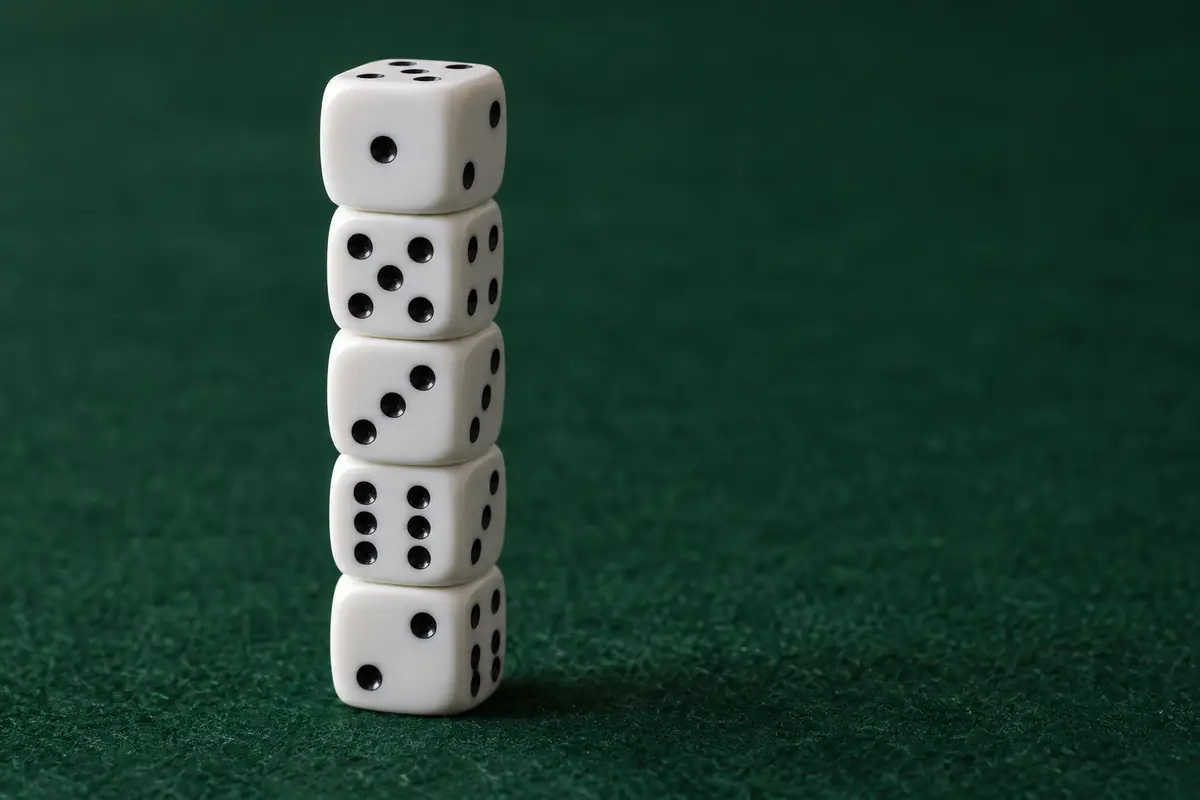
Five dice produce 7,776 possible outcomes. That number is small enough to count every one, so the chances below are exact rather than estimated.
One roll in 1,296 is five of a kind
There are exactly six ways to roll five matching dice, one for each face. Against 7,776 outcomes that is a 0.08 per cent chance on a single roll.
You get three rolls a turn and can keep dice between them, so a Yahtzee is far more likely across a whole turn than this number suggests. It is still the rarest thing on the card.
A large straight is rarer than a full house
A large straight comes up 240 times in 7,776, which is 3.09 per cent, or about one roll in 32. A full house of exactly three and two comes up 300 times, which is 3.86 per cent.
The large straight pays 40 and the full house pays 25, and the ordering of those scores matches the ordering of their odds.
Four of a kind is rarer than either
Four matching dice or better appears 156 times in 7,776, which is 2.01 per cent, or one roll in 50. That makes it rarer than both straights and the full house.
It pays the total of all five dice rather than a fixed score, so its value swings with the numbers you match. Four sixes pays far more than four twos.
Small straights are common enough to plan around
Four in a row or better turns up 1,200 times in 7,776. That is 15.43 per cent, or roughly one roll in six.
Three of a kind or better is more common still at 21.3 per cent, about one roll in five. These two are the reliable boxes, which is why spending them early on a weak roll costs more than it looks.
What the numbers change
Chase the rare boxes early, while you still hold enough turns to miss and recover. Leave the common boxes for later, because you are likely to fill them without trying.
The exception is the upper section, where the bonus rewards steady collecting rather than luck. That one is covered separately.